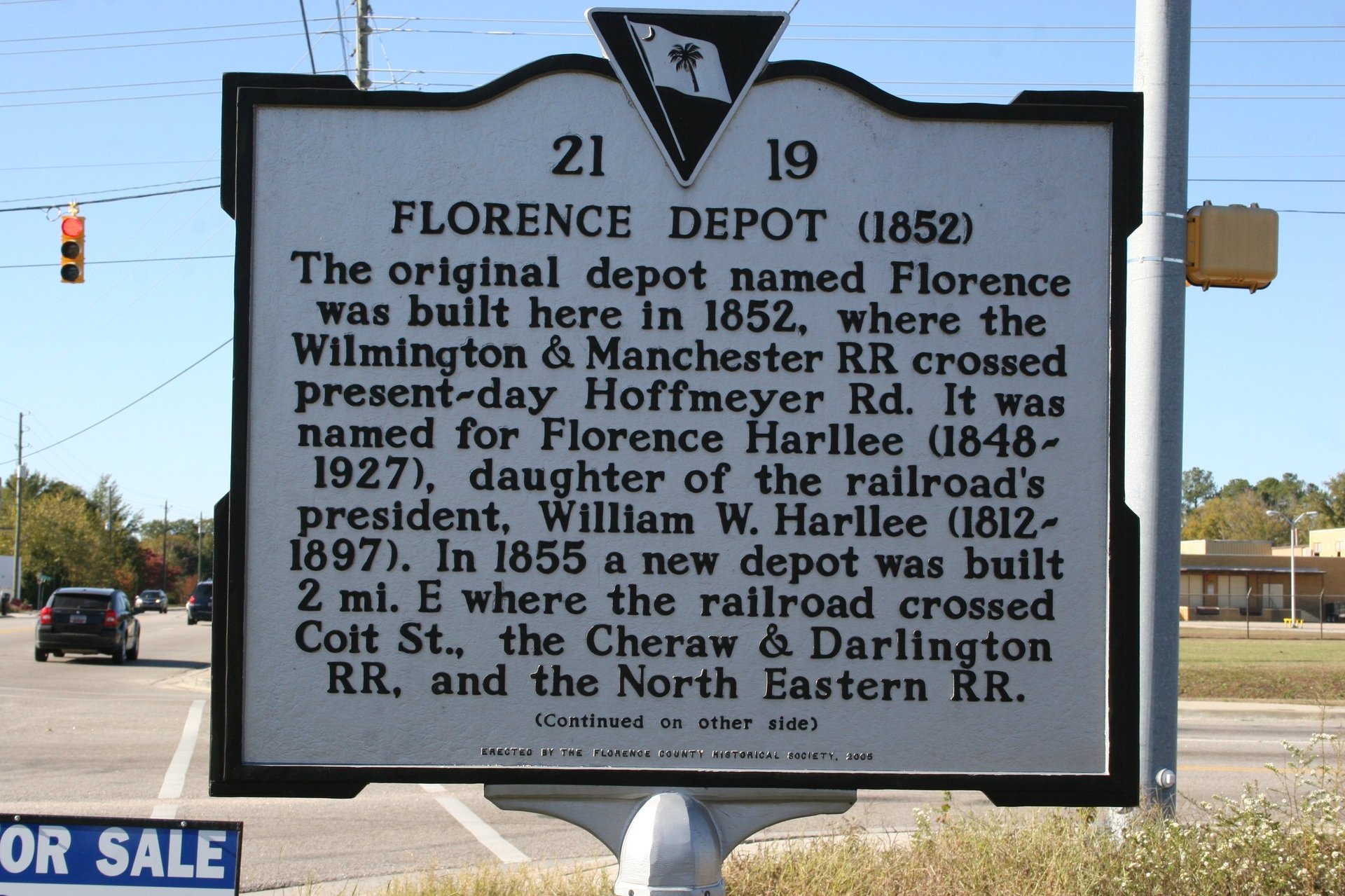
Historical marker sign 21-19 describing the Florence Depot built in 1852, located on a roadside with cars and trees visible
Est. 1852 Florence
Florence Stories

The Magic City: How Florence, South Carolina Got Its Name and Earned It

It started with five acres of Pee Dee scrubland and a railroad man who named a town after his daughter. What grew from that spot became one of the fastest-rising cities in the South.

By HelloFlorenceSC.com Staff | Florence, S.C.

There was nothing here.

That is where the story of Florence, South Carolina begins. Not with a town square or a church or a courthouse, but with a patch of flat Pee Dee earth in 1853, five acres purchased by the Wilmington and Manchester Railroad Company for the purpose of building a depot. No settlers had gathered there by design. No planner had drawn it on a map and called it a city. It was a crossing point, a dot on a rail line, a place where three sets of tracks would eventually meet and where, by the logic of commerce and geography, something had to be built.

What got built was Florence. And within fifty years, people were calling it the Magic City.

The Name Florence

The name Florence itself came from a railroad man with a soft spot for his daughter.

General W.W. Harllee was president of the Wilmington and Manchester Railroad, the first of the three lines to lay track through the Pee Dee region of South Carolina. When his railroad purchased those five acres and set about planning the depot site, Harllee gave the crossing his daughter's name. Florence Henning Harllee was the girl who would become, without ever knowing it, the namesake of a city. She was not a war hero or a politician. She was a daughter, and her father thought well enough of her to write her name into the landscape of South Carolina.

The town was officially chartered on March 9, 1871. By then, two more railroads had joined the Wilmington and Manchester at the crossing: the North Eastern and the Cheraw and Darlington. Three rail lines meeting at one point in the flat coastal plain of northeastern South Carolina meant one thing. Everything moving between the Atlantic coast and the interior of the region had to come through Florence. Cotton from Pee Dee farms. Timber from Pee Dee forests. Soldiers and artillery during the Civil War, when the rails ran hot with the movement of Confederate troops heading toward Richmond, Charleston, and Savannah. Union prisoners, too, were brought to Florence by rail, held at the Florence Stockade on the edge of town. More than 2,800 of those men died there. They are buried today in the Florence National Cemetery, a quiet federal ground that sits as one of the more somber reminders of what this crossroads city witnessed in its earliest years.

After the War, Florence Got Back to Business

After the war, Florence got back to the business of growing.

The rails were repaired. Fields were planted. Businesses reopened and new ones arrived. By the 1870s, the village had a population of about 700 people. The railroad kept pulling workers, merchants, and families into town, and by the end of that decade the population had more than doubled. Florence County was created in 1888. Two years later, the City of Florence was officially chartered and named the county seat.

Then tobacco arrived.

Cotton had long anchored the Pee Dee economy, moving out of the region by rail to markets up and down the eastern seaboard. But bright leaf tobacco proved to be something else. It was a faster, more valuable crop, and Florence sat at the center of the trade. The train yard ran day and night. The population of 3,395 recorded in 1900 more than tripled by 1920. Streets got paved. A waterworks system went in. An opera house opened. A library was built. Churches went up across the city, Presbyterian, Episcopal, Baptist, Methodist, Roman Catholic, a Jewish congregation, and a large number of African American churches that formed the backbone of communities the rest of the city was slow to acknowledge.

People looked around at what had become of that five-acre depot site and reached for a word large enough to describe it. The word they landed on was magic.
"By the turn of the century, Florence was prospering. The train yard was active, and a new crop, tobacco, bolstered the economy. Florence became known as the Magic City."
— Carolina Stories, Knowitall.org

The nickname was not unique to Florence. Birmingham, Alabama earned it too, for the same reason: a city that seemed to rise from nothing in a matter of decades, fueled by industry and geography and the particular American hunger for what comes next. But in Florence, the name stuck because the story underneath it was true. This was a place that should not have existed, and then did, and then grew into something no one had exactly planned.

The Twentieth Century: New Layers of Identity

The twentieth century layered new identities on top of the old one.

When World War I drew the country's attention, Florence's rail traffic hit its peak. Soldiers moved through the city's lines in both directions. The 1920s and 1930s brought schools, a museum, and the kind of civic investment that signals a community starting to believe in its own permanence. Then came World War II and an Army air base on the edge of town. After the war, the city pushed westward, eventually covering nearly 10,000 acres.

The railroads began to fade. But Florence had learned something from its founding: the city's survival had always depended on being at a crossroads. When rail declined, the crossroads simply changed form. In the 1950s and 1960s, US Highway 301 ran straight through Florence, and the city sat almost exactly halfway between New York and Miami. Every motorist driving the eastern seaboard passed through. Hotels filled. Restaurants opened. Florence became a place people stopped, which meant it became a place people spent money, and sometimes stayed.

Then came the interstates. I-95 and I-20 intersect on the western edge of Florence, the same logic as those three rail lines in 1853, updated for the age of the automobile. The junction pulled manufacturers. General Electric came. Honda built a plant in the county. Otis Elevator. QVC. The healthcare industry grew around McLeod Health until it became one of the dominant economic forces in the entire region. By 2009, the Florence area's total economic output reached $6.8 billion, among the highest in South Carolina.

In 1965, the National Civic League named Florence an All-American City. The downtown has since been rebuilt around a new library, a performing arts center, a renovated museum, and the kind of walkable blocks along Evans Street and South Dargan Street that a city puts together when it is thinking about the future.

The Magic City nickname does not show up on official signage. The city's current brand is Full Life. Full Forward, adopted in 2017 after the city spent a year and a half interviewing more than 700 residents about what Florence meant to them. The answers pointed toward something the railroad men of the 1850s would probably have recognized: a place built for movement, that learned to stay.

But the old nickname still circulates. You hear it in conversation. You see it in local writing. It turns up in tourism guides and history books and on the lips of people who know that Florence has a story worth telling, and that the story starts with something that felt, at the time, like it came from nowhere.

Five acres of Pee Dee land. Three railroad lines. A daughter's name. A city.

You could call it a lot of things. Magic is as good a word as any.

Explore the History of Florence, South Carolina

To learn more about the city's railroad origins, visit the Florence County Museum at 111 West Cheves Street in downtown Florence.

Visit HelloFlorenceSC.com

Florence Stories is a community feature series covering the people, places, and history of Florence County, South Carolina.