Florence, SC & the Pee Dee Region
Your Community Guide
29501 · The Community Hub
Since 1990, House of Hope of the Pee Dee has served thousands of men, women, and families across Florence, SC — offering shelter, addiction recovery, job training, and a path forward.
Jean and Bill Fryar didn't have a plan. They had a credit card and a calling.
In 1988, the Florence couple watched a local shelter turn away as many as 20 people in a single night. There was nowhere for those people to go. Instead of walking past that problem, the Fryars walked toward it. They stepped out in faith, bought an old school building, and opened what they called New Life Rescue Ministry in 1990. A Sunday school class at First Baptist Church Florence took notice and became their first board of directors. The nonprofit status followed. The mission took root.
More than 30 years later, that act of faith has grown into one of the most comprehensive homeless and recovery ministries in South Carolina. House of Hope of the Pee Dee now offers nearly 20,000 nights of shelter per year to men, women, and children in need. In 2022 alone, the organization served more than 50,000 meals to guests and residents across its facilities.
What separates House of Hope from a standard shelter is the range of what they offer once someone walks through the door.
CEO Bryan Braddock leads the organization today with a phrase that shapes everything they do: "Changed lives change lives." It is not a slogan. Several staff members currently working at House of Hope are former residents of the very programs they now run. A man who spent three decades in prison entered the Life Recovery Program and received the Christian discipleship, life-skills training, and community support he needed to get a job, buy a home, and rebuild his life entirely. A young couple arrived in a battered car, pregnant and battling addiction, with nowhere to turn.
"At the shelter, we don't turn anyone away. Depending on the situation, it could be life or death. It's the difference between hope and hopelessness."
— Bryan Braddock, CEO, House of Hope of the Pee Dee
The people who come through the door are not who most Florence residents picture. Among those who have sought emergency shelter at House of Hope are college graduates, teachers, and working professionals. For most, Braddock says, it was not a single decision or failure that led them there. It was two or three things hitting at once — a job loss, a health crisis, a relationship ending — from which they could not recover fast enough. More than 500 people are unhoused in the Pee Dee region at any given time. House of Hope serves up to 1,500 of them per year, with an estimated 60 new guests arriving every month.
Not every part of the House of Hope story belongs to the organization alone. Some of it belongs to Florence.
In 2015, a woman named Courtney McGinnis Graham died unexpectedly at the age of 46. She had spent her life advocating fiercely for Florence's most vulnerable residents, and her dream — one she had pursued with what those close to her described as tenacity, passion, and commitment — was a dedicated emergency shelter for the city's homeless population.
After her death, her family reached out to House of Hope with a question: could they partner to make Courtney's dream real?
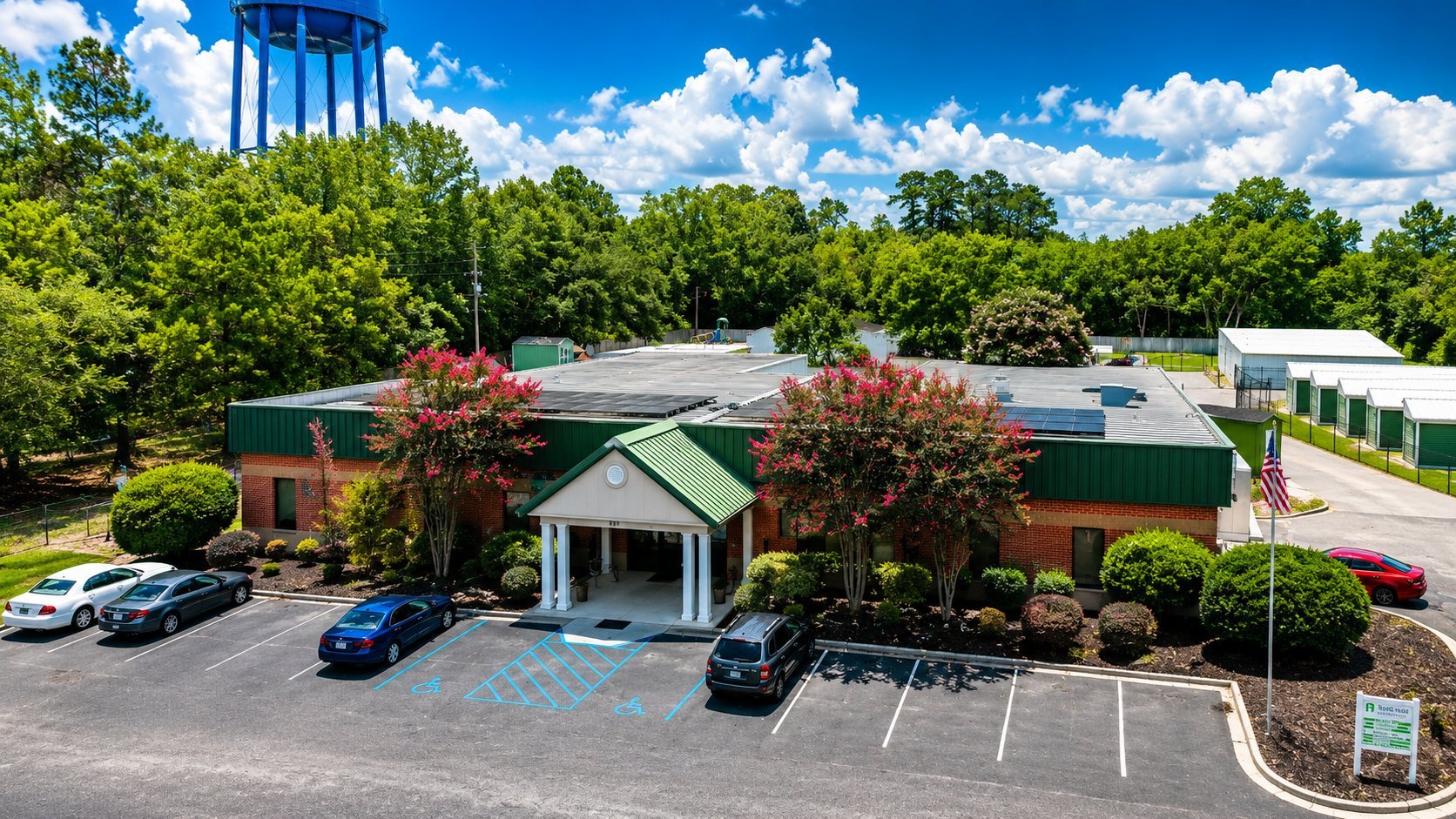
The answer was yes. In October 2016, the Courtney McGinnis Graham Community Shelter opened at 535 S. Church Street. The Rev. William F. Malambri III, then pastor at Central United Methodist Church, said of Courtney at the time: "She wanted this shelter to exist because she had concern for those that too many would rather ignore."
The Eastern Carolina Community Foundation's Blackwell Ervin Family Fund established a designated endowment in Courtney's memory to provide the shelter with a permanent annual income stream. Her name on that building is not honorary. It is a promise kept.
Today the Courtney McGinnis Graham Community Shelter operates 365 days a year, housing up to 12 men, 11 single women, and three families each night. More than 1,100 unique individuals pass through its doors every year. Local churches and organizations have furnished and decorated the rooms to make guests feel at home rather than warehoused. Church groups and workplaces bring in monthly meals. Case managers help guests search for jobs using on-site computers and assess what each person needs to move toward stable housing.
House of Hope has never operated alone. What Braddock has built over the years is less a single ministry and more a coordinated safety net, woven together with the wider Florence nonprofit and faith community.
Harvest Hope Food Bank provides food distribution support. Mercy Medicine Free Clinic, which has served Florence and Williamsburg counties for more than 24 years, supplies free medical care to low-income uninsured adults. Lighthouse Ministries handles financial crisis assistance — bill help, prescription medications, travel assistance — for residents working toward stability. Police departments, hospitals, churches, and other shelters all serve as referral sources, sending people to House of Hope when they have nowhere else to go.
The faith community is woven into the day-to-day in ways that go beyond Sunday. Life Recovery Program graduations are held at Compassion Church. The Whosoever Church on the Church Street property opens as a cooling station during heat emergencies, providing cold water and refuge for anyone who needs it.
House of Hope established a designated agency endowment through the Eastern Carolina Community Foundation in 2014 — a long-term financial stability move that allows the organization to accept planned gifts and unique assets, ensuring the mission outlasts any single season of giving.
The Men's Life Recovery Program runs for up to a year. It covers addiction recovery, Christian discipleship, financial literacy, job training, and job placement — the full arc from crisis to self-sufficiency. When a man graduates, he leaves with a job, savings, and transportation. The finish line is not sobriety. It is independence.
Florence-Darlington Technical College is part of that journey. HOPE Village residents — women and children in long-term transitional housing at the tiny home community on West Darlington Street — are actively pursuing certifications through FDTC. One resident recently completed her Forklift Certification through the college. Another, the HOPE Village Director, spent years working through addiction, legal challenges, and separation from her children before achieving custody and stepping into leadership. Her story is not unusual at House of Hope. It is the point.
The Jobs for Life program gives residents the professional framework to enter or reenter the workforce with more than a resume — with confidence, references, and a plan. Local businesses including Bank of Clarendon, Field Fastener, HopeHealth, Adams Outdoor, Pepsi of Florence, and Butler's Fine Men's Clothing have supported House of Hope's annual Hope Invitational Golf Tournament, putting their names behind the mission publicly.
The vision keeps moving forward.
House of Hope recently acquired 240 acres off Freight Road in Florence, a property called the Woods at Black Creek. Walk the land with Bryan Braddock and he will point to the future sites of zip lines, a par-3 golf course, and glamping facilities already available to the public through Hipcamp. Revenue from the property funds the ongoing ministry — a sustainable model that reduces dependence on donations alone.
The longer plan for those acres goes further still. Braddock is working toward a gated community where residents can purchase mobile tiny homes and lease space — a direct answer to the affordable housing gap that sends people back into a Pee Dee rental market many of them cannot yet afford. Putting someone in a house, he notes, does not solve homelessness if the underlying issues remain unaddressed. House of Hope's model addresses both.
The Evening of Hope — the organization's annual flagship fundraiser held at the Florence Center — has brought Dr. Ben Carson, NFL Hall of Famer Jim Kelly, comedian Jeff Foxworthy, and surfing legend Bethany Hamilton to Florence. The event raises awareness and funds, and it signals something else: this is a ministry that Florence's broader community has chosen to stand behind, year after year, with time and money and names attached.
In 1988, Jean and Bill Fryar watched twenty people get turned away with nowhere to go. They could have driven home. Instead, they started something.
What they started has become one of the most complete responses to homelessness and housing insecurity in the entire region — emergency shelter, long-term recovery, tiny homes, addiction treatment, job training, workforce certification, affordable housing development, and a thrift store that funds it all. And underneath all of it, a community: churches furnishing rooms, businesses sponsoring tournaments, a woman named Courtney whose dream became a building on South Church Street, and staff members who once needed help and now give it.
That is what the phrase means. Changed lives change lives.
And in Florence, that has been true since 1990.
Florence Stories is a community feature series covering the people, organizations, and neighborhoods of Florence County, South Carolina.